We all run operating system on our machines. macOS and Windows coordinate processes, manage memory, allocate resources — invisibly, continuously, without anyone clicking “approve” on each task. Our laptops had this for forty years.
The enterprise never had the equivalent.
Instead, it has humans. Thousands of them, spending 30% or more of their working hours acting as the connective tissue between applications — copying data from one system, pasting it into another, cross-referencing a third, drafting an email to summarise what the fourth one said. The most expensive middleware in history is us!
That gap is about to close. What’s emerging in 2026 isn’t another chatbot layer or another vendor’s AI assistant bolted onto an existing product. It is something structurally different: an agentic orchestration layer that sits atop the enterprise’s data estate, connects its siloed applications, and — here’s where it gets interesting — delivers a fully personalised, anticipatory interface to every employee. An operating system, in the truest sense, for the enterprise itself.
Focus On: The Rise of the Agent OS
The term “Agent Operating System” entered the lexicon through open-source projects, not enterprise vendors. OpenClaw demonstrated the concept at the individual and small-team level: a skills-based architecture where autonomous agents run on schedules, draw from multiple data sources via the Model Context Protocol, maintain persistent memory across conversations, and deliver outputs through whatever channel the user prefers. Telegram, Slack, email, WhatsApp. The agent wakes up, does the work, and reports back.
In February 2026, a new entrant called OpenFang pushed the concept further. Built from scratch in Rust — 137,000 lines of code compiled into a single binary — OpenFang explicitly positions itself not as a chatbot framework but as an operating system for autonomous agents. Its key innovation is what it calls “Hands”: pre-built autonomous capability packages that run independently, on schedules, without requiring a human to prompt them. A Researcher Hand that monitors your competitors at 6 AM and delivers a scored intelligence report to your dashboard before you’ve had coffee. A Lead Hand that generates and qualifies prospects overnight. A Browser Hand that automates multi-step web workflows with mandatory approval gates before any financial transaction.
The distinction between a library and an operating system matters enormously here. CrewAI, AutoGen, LangGraph — the incumbent Python-based multi-agent frameworks — are libraries. They require a developer to wire things up, manage state, handle failures. An OS does all of that invisibly. It manages agents, allocates resources, enforces permissions, schedules tasks, maintains audit trails. Just as macOS manages your applications, an Agent OS manages your agents. That is a category maturation, not an incremental improvement.
Now here’s the thing. What open-source projects demonstrate at the individual level today is what enterprise platforms will deliver at scale within 18 to 24 months. The hyperscalers and SaaS vendors know this. Microsoft has Agent 365. Salesforce has Agentforce. SAP has Joule. ServiceNow has its AI Agents platform. Nvidia launched its Agent Toolkit at GTC 2026 with 17 enterprise software companies as launch partners, including a reference architecture where Slack becomes the primary conversational interface for Agentforce agents — drawing from data stores in both cloud and on-premises environments.
But there’s a problem with every vendor-specific solution. They are scoped to their own ecosystems. A Salesforce agent orchestrates Salesforce workflows beautifully. It doesn’t know what’s happening in your SAP instance, your Workday environment, or the proprietary analytics platform your data science team built three years ago. Enterprise environments are heterogeneous by design and by history. The orchestration layer that actually works must be cross-stack.
This is where the Model Context Protocol becomes the connective tissue. MCP — open-sourced by Anthropic in late 2024, adopted by OpenAI and Google DeepMind in 2025, and donated to the Agentic AI Foundation under the Linux Foundation in December 2025 — is an open standard that lets AI agents connect to any tool, data source, or other agent through a universal interface. Think of it as what REST did for the web: a structured architectural pattern that replaces fragmented proprietary integrations with a shared protocol. Gartner predicts 75% of gateway vendors will have MCP features by the end of 2026. The protocol already sees 97 million monthly SDK downloads across Python and TypeScript. It won’t be the only standard — Google’s A2A protocol handles agent-to-agent communication — but MCP is rapidly becoming the default for how agents access enterprise data and tools.
The 2026 MCP roadmap, published in March, makes enterprise readiness one of its four top priorities. The gaps are real and acknowledged: no standardised audit trails, authentication still tied to static secrets, undefined gateway behaviour, configuration that doesn’t travel between clients. Multi-tenancy isn’t yet addressed. These are solvable problems, but they explain why enterprise deployment is lagging individual adoption. The protocol works. The governance around it is still being built.
The Data Layer Is the Actual Bottleneck
I want to be direct about something. The conversation about agentic AI is dominated by talk of models and agents — which LLM, which framework, which orchestration platform. That conversation, albeit important, often misses the key prerequisite.
The decisive factor is the data.
An agent is only as capable as the data it can access in real time. If your enterprise data sits in dozens of siloed systems — each with its own access controls, its own schema, its own latency characteristics — then your agents will be precisely as limited as the human who previously had to open twelve browser tabs to assemble a picture of what was happening. The agentic layer doesn’t solve bad data architecture. It amplifies it.
This is why the most consequential announcements in enterprise AI this quarter haven’t come from model providers. They’ve come from data infrastructure companies. Oracle, at its AI World Tour in London on 24 March, announced what it calls “Unified Memory Core” — a converged data engine where transactional data, vector embeddings, graph relationships, and spatial data coexist in a single architecture. Their argument: the database itself should be the operating system for enterprise intelligence. They also launched “Vectors on Ice” — enabling AI vector search directly on Apache Iceberg data lake tables — which unifies search across operational databases and data lakes in a single query.
Google Cloud and Ab Initio made a complementary move in February: joint data connectors, metadata connectors, and agents that enable agentic AI to operate across multi-cloud data estates. The key principle here deserves emphasis. Data can remain distributed and heterogeneous — that’s reality for every large enterprise. But metadata must be unified and standardised. Without consistent lineage, governance, and semantic context, agents cannot reason reliably. They hallucinate. They act on stale information. They make decisions that look plausible and are wrong.
Databricks offered perhaps the most vivid proof of concept with Lakewatch, its new agentic SIEM that runs security directly on the lakehouse. The insight that matters well beyond the security use case: organisations already possess the context they need to act. HR systems, collaboration platforms, application logs, transaction data — it all sits in the lake already. Traditional tools can’t access it without expensive duplication. Lakewatch lets agents correlate across any data source without moving files or switching tools. The architecture, not the model, is the breakthrough.
EY’s CIO Playbook on Agentic AI makes this explicit. It calls for increased focus on data lakes, data streaming and pipeline infrastructure, APIs and middleware, AI-friendly cloud architecture, and data governance as prerequisites for agent workloads. Not nice-to-haves. Prerequisites. And the data tells a sobering story: according to industry research, 70% of organisations discover their data infrastructure is inadequate after launching AI initiatives. The moment of truth typically arrives six months into a project, when a successful pilot needs to scale and the foundational data architecture simply can’t support the workload.
I wrote in a previous issue of Chronicles of Change about the migration of SaaS profit pools — how value is shifting from per-seat licensing toward orchestration and data access. The agentic layer accelerates this shift, but the framing matters. SaaS applications aren’t being replaced. They’re being repositioned as data infrastructure. The CRM, the analytics platform, the content management system — these persist. What changes is how humans interact with them. And that change is the real story.
The Death of the Generic Enterprise Interface
The endgame of the agentic layer isn’t better automation. It is the end of the generic enterprise interface.
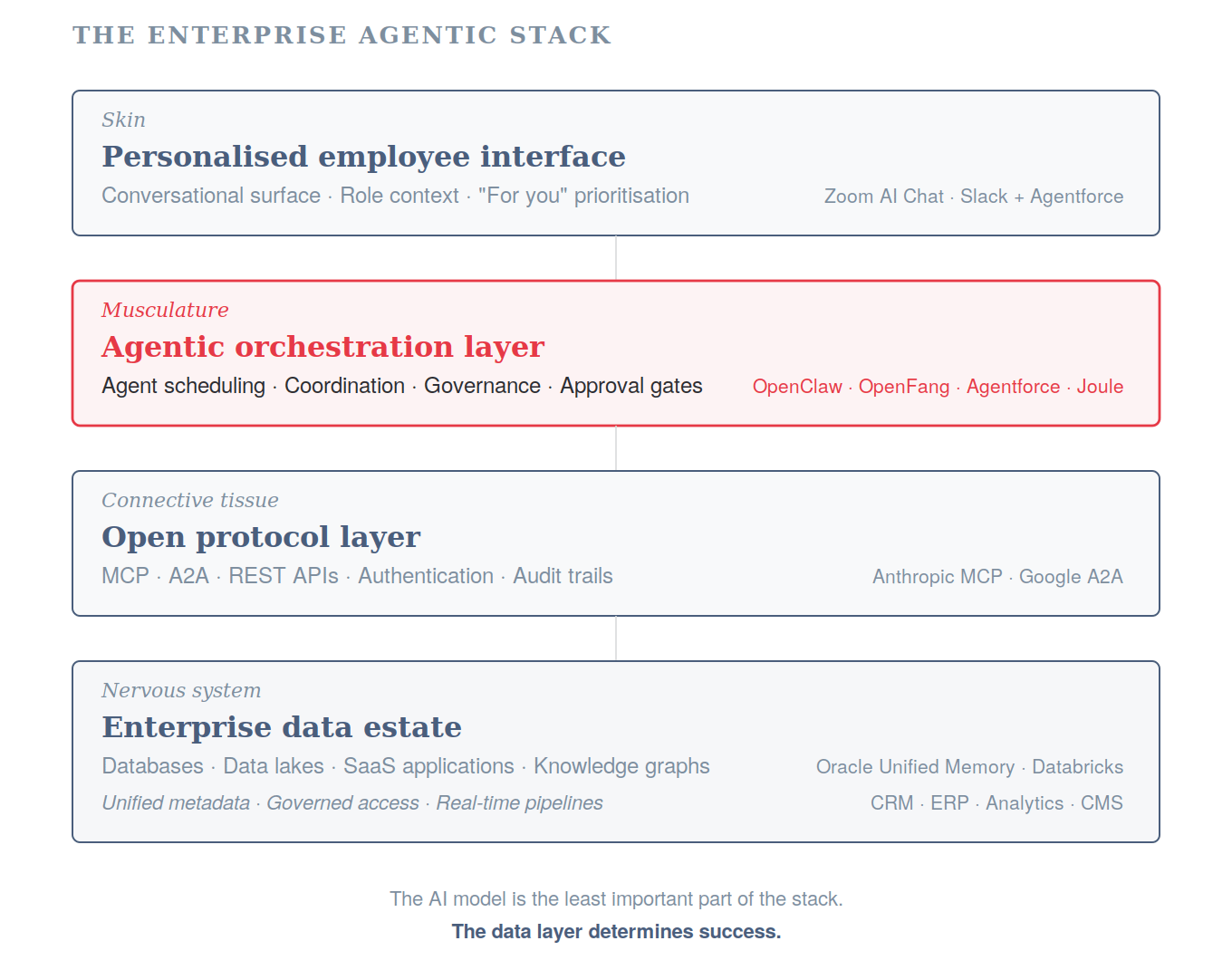
When an orchestration layer sits between the employee and the data estate — perceiving context, maintaining memory, understanding permissions and role — every employee gets an interface shaped by their specific needs in their specific moment. Not a dashboard designed for a role. Not a report generated on a schedule. A living, anticipatory surface that synthesises information from multiple sources in real time and presents exactly what that person needs to make their next decision.
Gartner’s Strategic Predictions for 2026 put a number on this: GenAI and AI agent use will create the first true challenge to mainstream productivity tools in 35 years, triggering a $58 billion market reconfiguration. EY predicts that traditional user interfaces will fade as agents interact via APIs, making dashboards and heavy UIs largely obsolete. IDC expects AI copilots embedded in nearly 80% of enterprise workplace applications by 2026, and 85% of executives surveyed believe employees will rely on AI agent recommendations for real-time, data-driven decisions.
Zoom’s March 2026 announcement made this tangible. Its expanded agentic AI platform introduces “AI-first Chat” — custom agents available inside the messaging interface, topic-based summaries, and “For You” prioritisation that surfaces what matters most. The UX explicitly moves toward a single conversational surface that anticipates needs. Salesforce and Nvidia’s GTC reference architecture does the same from the CRM side: Slack becomes the command centre for corporate AI, with Agentforce agents pulling from both cloud and on-premises data stores.
For marketing leaders this is where the transformation gets personal. My ideal agent layer draws simultaneously from our CRM, our analytics platform, our competitive intelligence feeds, our content management system, and our social listening tools. It synthesises them into a single decision surface. Not a dashboard with five tabs. A conversation that already knows what I need because it has the context of my calendar, my current projects, my team’s capacity, and the market signals that changed overnight.
This matters profoundly because the value of enterprise data — particularly structured, high-quality, governed data — increases in the agentic paradigm. Data providers become more critical, not less. The risk isn’t disintermediation. The risk is invisibility. If your data isn’t accessible via MCP or equivalent agent-friendly protocols, it won’t surface in the agentic workflow. It won’t inform the agent’s recommendation. It won’t exist in the employee’s anticipatory interface. For any company whose value proposition rests on data — and that includes the company I work for — agent accessibility is now a first-order strategic priority.
What This Demands of You
The numbers paint a picture of urgency tempered by reality. Gartner says 40% of enterprise applications will embed AI agents by the end of this year — up from under 5% in 2025. The agentic AI market is projected to reach $52 billion by 2030. BCG reports 58% of companies have already integrated agents into operations. KPMG’s Q4 AI Pulse Survey shows enterprises projecting an average of $124 million in AI deployment over the coming year, with half planning $10–50 million specifically for agent security infrastructure.
And yet. Deloitte’s 2025 Emerging Technology Trends study found only 11% of organisations have agentic solutions in production. Thirty-five percent have no formal agentic strategy at all. The gap between ambition and execution is wide enough to drive a transformation programme through — which is exactly what the next 18 months demand.
Three things need to happen.
Your data estate must become agent-ready. That means unified metadata, governed access, real-time pipelines, and semantic context that agents can reason over. If you’re treating your data lake as a reporting backend, you’re building the agentic equivalent of a house on sand.
Your integration architecture must support MCP or equivalent open standards. Every data source, every application, every internal tool that agents will need to access must be reachable through a standardised protocol with proper authentication, audit trails, and permission scoping. Without this, you’ll get what Mirantis aptly calls “Shadow Agents” — unvetted AI running on developer laptops, accessing critical systems without governance. The shadow IT problem, reprised in a more dangerous form.
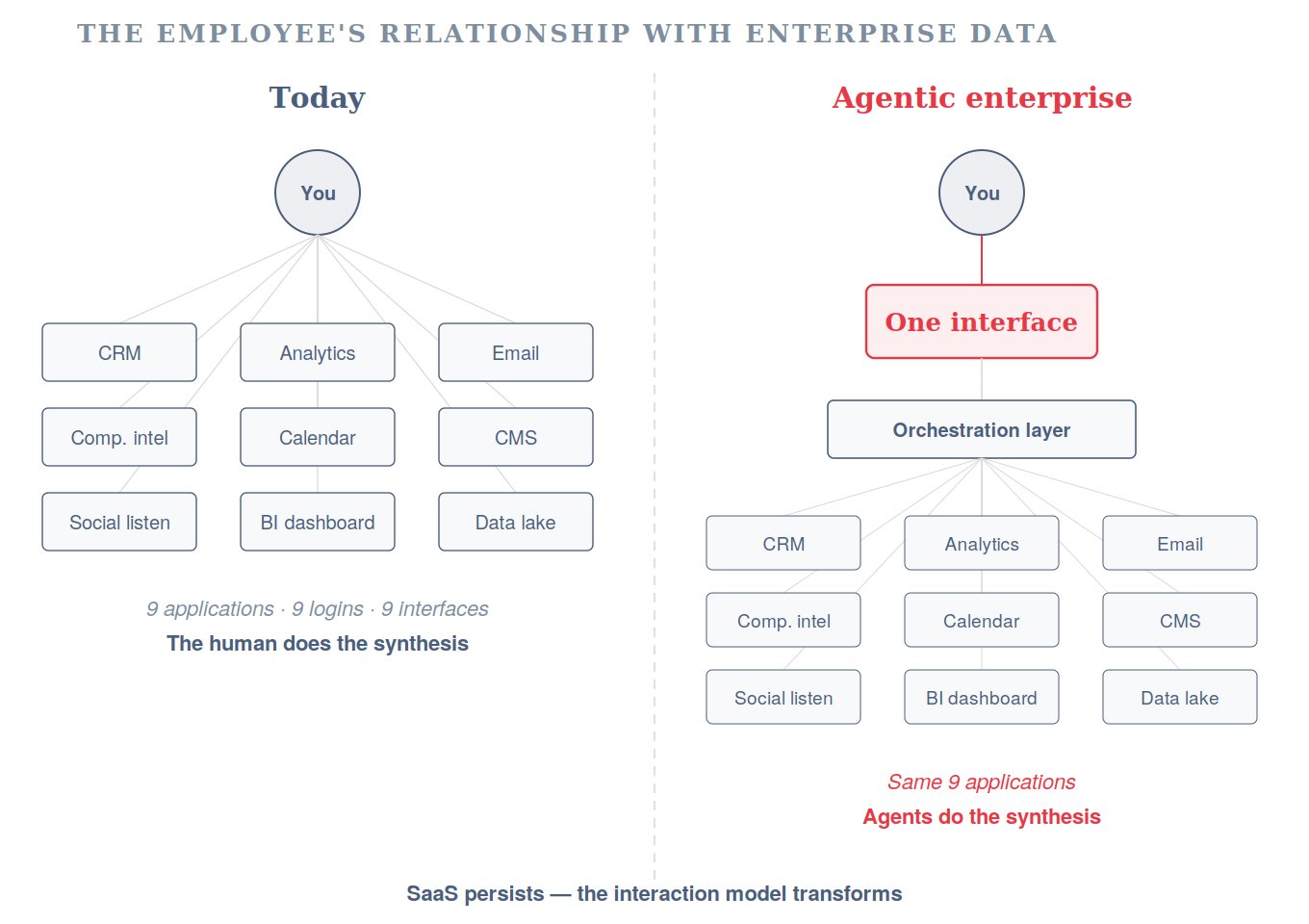
Your organisation must decide what the employee interface of the future looks like. Not which vendor’s copilot to deploy — that’s a procurement question. The strategic question is whether you’re building toward a world where every employee has a personalised, anticipatory decision surface powered by the full breadth of your enterprise data. Because that is what’s coming. The only variable is whether you design it or inherit whatever your vendors decide to ship.
The enterprises that will define the next era are those that recognise something counterintuitive: the AI model is the least important part of the stack. The data layer is the nervous system. The orchestration layer is the musculature. The personalised interface is the skin — the surface through which every employee touches the intelligence of the entire organisation.
The operating system your enterprise never had? It’s being built now. The question is whether you’ll architect it, or whether it will arrive piecemeal, ungoverned, and shaped by someone else’s priorities.
Follow me
That’s all for this week. To keep up with the latest in generative AI and its relevance to your digital transformation programs, follow me on LinkedIn or subscribe to this newsletter.
Disclaimer: The views and opinions expressed in Chronicles of Change and on my social media accounts are my own and do not necessarily reflect the official policy or position of S&P Global.